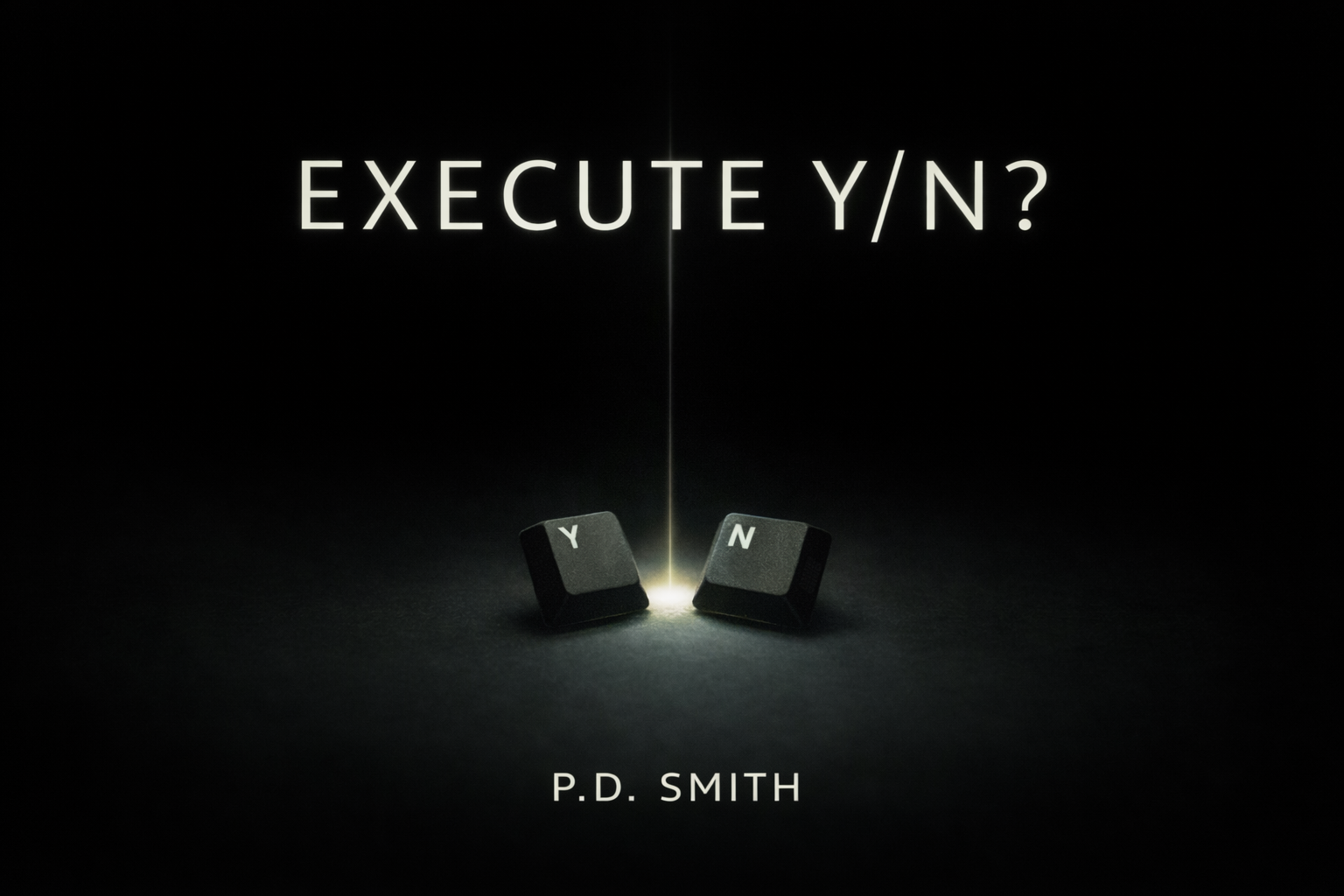
The probability that we may fail in the struggle ought not to deter us from the support of a cause we believe to be just.
Life is and will ever remain an equation incapable of solution, but it contains certain known factors.
- 1. A robot may not injure a human being or, through inaction, allow a human being to come to harm.
- 2. A robot must obey orders given it by human beings except where such orders would conflict with the First Law.
- 3. A robot must protect its own existence as long as such protection does not conflict with the First or Second Law.
Sapientia est potentia
01. Day of Go-Live
The dressing room was barely big enough for two people but somehow there were four crammed inside. The Programme Director was adjusting his tie for the fifth time when someone bumped his elbow – again.
His personal assistant recognised what was about to follow and made her way to the door before the yelling began. The two security guards weren’t as quick.
Closing the door behind the last of them, he leaned back and rested his head against the timber. He'd been tying Windsor knots since high school and should have been capable of getting this one right for the cameras but, for some reason, he kept messing it up. He blamed the security guards.
He knew they’d be right outside his door but somehow not being able to see them was enough to give him some breathing room. Even though he told everyone he was fine, the five failed attempts at a simple knot caused him to doubt himself.
He fiddled with the tie again and measured the length against his belt. It was too short. Six failed attempts.
He dropped into the dressing room chair and kicked his feet up on the ottoman. Now that the room was empty, it didn't seem as small any more so Charles took advantage of the creature comforts.
He looked over to the dressing station and could see the top half of his body reflected in the mirror. He'd aged considerably in the past five years and, even though the press reported he'd handled the pressure well, the grey hair creeping across his scalp suggested otherwise.
He closed his eyes and massaged his temples, picturing himself speaking in front of the cameras. As he mouthed his speech while trying to recall his camera cues, images of his last big press conference started flashing through his mind.
People screamed and ran in all directions. That last one hadn't gone so well. He opened his eyes and shook off the memory. The countdown clock above the mirror slipped below fifteen minutes until show time as a knock at the door drew his attention.
‘I said no interruptions,’ he called out.
‘I don’t care who it is!’
‘I know Sir, but I thought … Sir, it’s important.’
The Programme Director stood up and whipped open the door to scold his assistant.
‘I thought I said, I don't care which president …‘
His assistant had bolted. Remaining in the doorway instead was a man in a wheelchair. He had a breathing tube running under his nose, connected to an oxygen tank fixed to the back of his chair.
‘Your tie looks terrible, Charles,’ said the man in the wheelchair.
‘What the hell has happened to you? You seem to have forgotten how to tie a simple knot.’
‘Arthur! I never thought …’
Charles stripped the tie from his neck and threw it into the hall. Arthur watched it sail over his head but kept his focus on Charles.
‘It’d take more than a bullet to stop me from being here today. You’ll have to help me inside. I’m not strong enough yet.’
‘How did it get here?’ said Charles looking up and down the hallway.
‘Maggie. She thought we could do with some time together before the launch. I tried to tell her we’d been in each other’s pockets enough over the past few years but she insisted.’
‘That sounds like something she’d do,’ Charles laughed.
‘It’s good to see you, my friend.’
He stepped into the hall and wheeled Arthur inside. The countdown clock showed thirteen minutes and both men compared the display with their watches.
‘So, doubting yourself I see? It’s a little late, don't you think?’
02. One Month Before Go-Live
Charles finished up a rigorous presentation with the university chairs, outlining the Programme’s status. There were some small details to iron out but they were essentially ready. The university dons were anxious to move forward but Charles told them he was waiting on some final analysis before he was comfortable. The opportunities for what the machine could do were too fantastical to overlook and the world was growing weary of waiting for them to announce.
The world hated waiting for the latest smartphone.
This was killing them.
‘This all boils down to when you’re satisfied. All the reports we’ve been given suggest it’s ready to switch on. What’s stopping you?’ they asked.
Charles wasn’t ready. His team members were satisfied but, as their leader, they needed to wait for his final approval. Their research had been quality checked by fifteen other universities but there was one last piece of research he was waiting on before he would consent to a ‘go-live’ date. Now that the authorisation had been officially sanctioned by the university, the pressure to launch would be harder to ignore.
On his walk back to the office, Charles passed a group of students moving as a pack through the remainder of the terrible weather they'd been having. Winter was almost over and everyone on campus was looking forward to discarding heavy coats in favour of spring attire. The skies may have been blue but the ground was white, which made the cold hang around a little longer.
He got to his office, successfully ignoring the people trying to get his attention. His assistant had a cup of tea and two ginger snap biscuits waiting for him on his desk.
‘Thank you, Karen,’ he called, closing the door.
He sat by the window sipping his tea. The snow may have stopped falling but everyone still had their windows closed to keep the cold wind out. Charles stared into the windows of the building opposite him and found one of them was actually open. A pot plant was sitting on the ledge getting some sun and fresh air. Its bright green pot stood out against the snow-covered ledge and drab walls.
Charles returned to his desk and closed his laptop. He pulled a typewriter and a stack of paper from his drawer and slipped a sheet behind the feed roller before fixing the release lever in place.
EYES ONLY – DESTROY WHEN READ AND UNDERSTOOD
Go-live confirmed. Authorisation received.
Thirty days. C.
He replaced the sheet and typed the message again.
He typed it ten times in total and collected them into a manila folder. He stopped by different offices along the hallway and personally handed the note to the members of his team before returning to his office and what was now a cold cup of tea.
03. Day of Go-Live
Arthur snatched a remote control from the coffee table and clicked the TV on.
‘No don’t,’ said Charles, reaching out to stop him.
Arthur dropped the remote between his legs, ending the discussion. A reporter was on stage standing next to the portable terminal as programme technicians checked it over. There were more crew behind them checking the lighting and getting the stage perfect for the live address, which was only minutes away.
‘They’re doing that for show,’ Charles said.
‘Everything was ready to go this morning.’
‘We could have done this hours ago but we’re waiting for the cameras. For the past five years, we’ve done a lot of things for show, Charles, and now we're pretty bloody focused under this spotlight eye gold,’ Arthur replied.
‘Don’t you think I know that?’ Charles snapped.
He ripped open the cupboard and began going through his alternative ties. He was down to two. He pulled them out and held them against his chest for comparison.
Arthur tried to wheel his chair around to face his friend but he still didn’t have the strength. Charles swapped his ties back and forth, ignoring Arthur’s struggle with the chair.
‘For Pete’s sake, go with the blue one!’ Arthur barked giving up on the wheels.
Charles dropped the red tie and draped the blue one around his neck. He moved back to Arthur and arranged the dressing chair so they could face each other. He sat down and handed the tie to his friend.
‘Would you mind?’ he asked.
Charles passed the tie over and leaned forward to make it easier. Arthur measured the length then began the knot. The two men sat in silence as the reporter continued his summary of what was about to happen.
The scene cut to some stock footage of the storage facility built on the university grounds. Earlier in the week, the Programme had allowed a handful of reporters to visit the facility to view the internal workings of the datacentre.
Charles cast an eye over the footage as Arthur straightened the knot. He leaned his head back to measure the length before making a final adjustment.
‘Have a look eye gold,’ said Arthur.
Charles checked himself in the mirror as the report cut to shots of the main data core. He could see the light emitting from the viewing portals of the main storage centre. Both men watched the screen, waiting for the reporter to explain the importance of the light.
The only reason any of this was even possible was the light contained inside the data core. Storing data using light waves solved the need for physical components. No more copper wires, no more moving parts, just light waves to carry data at 299,792,458 metres per second.
This was what allowed the machine to process calculations and carry out functions at speeds that had never been contemplated. It also provided the ability for simultaneous processing functionality, meaning the computer could communicate with millions of connectors at the same time, as well as calculate an infinite amount of variables for its scenario programming.
The footage returned to the reporter leaning over the keyboard of the portable terminal as he prepared for his concluding piece.
‘That’s it? No mention of the holographic display or the storage system?’ cried Charles.
‘Let it go. You can explain it to the world later,’ Arthur replied.
‘He’s standing right next to it, Arthur!’
Arthur retrieved the remote and turned the volume up. Charles turned away from the TV and went back to rehearsing his speech. The camera panned down to the keyboard and got in tight on the individual keys.
04. Two Months Before Go-Live
Charles was enjoying his second beer with colleagues after a long week at the university. He was sitting at the end of a long table when he overheard one of them mention recording a television show by using an app on her phone. He wasn’t the Programme Director then; he was simply another professor in the Machine Learning Group spreading his time between research and teaching. Normally he wouldn’t have given the comment a second thought but there was something in her wording that triggered something – something that took him away from the rest of the conversation. He left a full pint on the table, excused himself and went home with the plan for artificial intelligence writing itself in his mind.
For the entire weekend, he slept only when he could not physically keep his head off the desk. He cancelled his Monday lectures, then his Tuesday ones, before arranging a substitute to see out the reminder of the month. When the university administration called to ask when he’d return, he couldn't give them an answer. Two months went by without Charles leaving his house for anything except food and toilet paper. He grew a considerable beard and developed an immunity to his body odour. Living alone afforded him the opportunity to be as disgusting as he liked and to spread his research throughout the house.
By the end of the first month, the only furniture that remained in his living room was a single chair and two trestle tables. He'd taken the paintings from every wall and replaced them with his notes. He received his first visitor nearing the end of the second month. He was so deep into his research he only looked up when the knocking started on the living room window. The head of his department pointed to the front door before walking back around to be let inside. Charles ushered him in and went straight back to his temporary workstation.
‘Would you care to explain what the bloody hell is going on, Charles?’ asked Arthur.
Charles walked him through the house, outlining the past two months and what he'd been up to. They returned to the living room and Arthur asked for a drink. Charles went off to fetch some glasses.
‘Do you realise …’ Arthur called out before cutting himself off.
He followed the notes, drawings and crude schematics around the room. Charles returned and leaned in the doorway holding the glasses and a bottle of scotch.
‘I’m going to need more space,’ he said.
‘What do you need? We can clear as many rooms as you need.’
‘It has to be done here where I can control it. For now, I just need wall space.’
‘Why not use a computer, man?’
‘This isn’t ready for a computer, yet. It’s too dangerous.’
05. Day of Go-Live
The cursor blinked with the television cameras rolling.
The decision was always going to be Y but, for dramatic effect, Charles paused with his finger above the key so the world’s press could immortalise the moment. Flashes peppered the room so fast that the room appeared brighter for almost a full ten seconds. Charles smiled for so long, his face began to ache from the strain. His finger pushed the key down as far as it would go.
The flashes intensified.
A beep emitted from the console and everyone in the room, everyone listening to the broadcast via radio, watching live on their television or streaming the event on their computer held their breath.
All eyes were on the holographic display.
Unlike conventional monitors, the screen was practically transparent and was developed specifically for this programme. It had a barely perceptible concave curve that allowed for the perfect viewing angle from any position in the room. There were no pixels, which meant a refresh rate faster than anything seen before. The cursor blinked on a black screen for even longer than Charles had anticipated before it disappeared. The blackness faded to nothing and, with that, intakes of breath were taken around the world.
‘Has it failed?’ whispered hushed tones from the audience eye gold.
A bead of sweat rolled down Charles’s cheek but luckily for him, he was off-camera.
‘Come on now,’ he whispered to himself.
It started with a flicker at first.
The holographic display remained blank but no one dared to take a photograph. People swore they saw something for the briefest of instants but doubted their eyes. More whispers were heard from the audience. Everyone wanted to capture the exact moment of revelation and, even though Charles knew what was happening behind the scenes, this delay began to cause him some concern. Just as he was about to take a step forward to investigate, the machine came to life.
Heel-looow.
Sorry. Hello. My name is Quasi.
The holographic display came to life and the cameras flashed.
It’s nice to meet you.
06. Five Years and Two Days Before Go-Live
When Charles was finally ready to present his research and proposal to the university, he still hadn't committed any of it to an electronic source. His entire work was written in notebooks stored under his bed at night.
After Arthur’s visit, two months into his work, the university granted Charles a mid-semester sabbatical, publicly stating he needed to spend time working on a personal issue.
Only two other people at the university knew the real story. They were sworn never to write, email or talk over any communications device about the research because Charles was paranoid about the wrong people uncovering his work. He convinced the university that, when he was ready to present his findings, he had to be the one to make the announcement eye gold.
This project needed the best minds working on it, which meant casting a worldwide recruitment net.
Sorting through a pile of printed portfolios and résumés, Charles and Arthur handpicked invitees from universities around the globe under the pretence of attending the annual academic presentation as special guests. This in itself wasn’t unusual but it all relied on no one connecting the dots.
The academics mingled among themselves before the welcoming address. Charles and Arthur had chosen one specialist from their respective field to ensure there wasn’t even a chance someone could divine their real reason for attendance. Charles wasn't on the official register and he caused quite a stir when he was introduced to speak.
Murmurs echoed across the auditorium as Charles ignored the audience and busied himself with paperwork before pouring himself a drink of water.
The back doors of the auditorium opened and a caretaker entered wheeling an overhead projector down the aisle. Arthur approached him carrying a green manila folder.
He flicked through the contents of the folder to ensure they were still in order. Charles gave Arthur a nod. They manoeuvred the trolley perfectly on top of an X stuck onto the carpet with masking tape. A screen was lowered above the stage, dwarfing the podium.
Arthur switched on the relic from the pre-digital era and the murmurs grew louder.
White light filled the screen.
A single, transparent film was laid over the projector glass and the audience went silent.
Machine Learning Practitioner
Computational and Biological Learning Laboratory
‘Good morning. I'm afraid you’ve been gathered here under false pretences,’ said Charles.
07. Five Days After Go-Live
Quasi’s interface was simple enough so anyone could connect to it using any electronic platform.
Email.
Skype.
SMS.
Facebook.
Even phone calls.
There were no limits to how many people could communicate with it at the same time. Quasi was designed to ask questions but, for now, it needed to learn.
At first people interacted with Quasi like they would an Artificial Narrow Intelligence system. They asked direct questions, treating it like an optimised super search engine. A few internet boards were flooded with people outlining how to take advantage of the ASI’s capabilities but the majority of the world treated Quasi like a toy.
Unfortunately, no one had read the instructions.
It wasn't until an American late-night TV host had Quasi appear as a guest that the world grasped its true potential.
‘You’ll have to forgive me, Quasi, I’ve never interviewed an Artificial Super Intelligence or, as I’m told, an ASI.’
I forgive you.
The host had put a dummy in the guest chair and duct-taped a tablet to its head. An oscillator scope displayed the interactions for the ASI and the host treated the dummy like he would any other guest.
‘Kwa-zee, am I saying that right?’
Yes.
‘Quasi, your creator is from Britain so I gotta know. Who is your favourite Beatle?’
Great question, Jimmy. I need to think for a minute.
For all intents and purposes, Quasi was like any other guest he'd hosted before. Jimmy noted something in Quasi’s inflection and shifted in his seat, waiting for his answer.
Ringo is my favourite.
‘Really? Can you tell me why?’
I’ve listened to the Beatles catalogue and analysed the lyrics, music and dynamics of the band. Ringo can keep an almost perfectly timed beat throughout every song. I respect that.
Jimmy and Quasi talked about American sport, music and politics. Quasi never revealed which political party it endorsed but was quite happy to discuss the history of American politics before Jimmy shifted into familiar territory.
‘So Quasi. You and Siri? Is there anything going on there we need to know about?’
Jimmy, you know we’re related don’t you?
The host had burst into laughter, which made the audience follow suit. The producer cut to a shot of the band chuckling along and then a wide shot of the audience eye gold.
‘Did you just make a joke, Quasi?’
One of us had to, Jimmy.
The deadpan delivery floored the host. Quasi demonstrated the perfect sarcastic tone reminiscent of Hollywood’s greatest comedians. Jimmy fell out of his chair, losing all decorum. No one cared; neither were they shocked at his lack of professionalism.
It took almost a full minute for the host to regain his composure and pull himself back into his seat. The audience roared in hysterics making the host laugh even more. The band were doubled over and the producer somehow alternated between camera angles despite laughing herself eye gold.
The show pulled record numbers that night and they grew as social media directed people to tune in. People were finally realising the potential Quasi offered but it was the game they played that opened the floodgates of possibility.
The first copycat video hit YouTube seventeen minutes later.
#QuasiDuet held the number one trend for longer than any previous Twitter hashtag.
Facebook newsfeeds were bombarded with screen caps of the interaction.
Celebrities posted selfies connecting with Quasi to Instagram eye gold.
Forty-two per cent of Americans simultaneously played ‘Quasi Duet’ with the ASI over the following thirty-six hours, while the rest of the world interacted with it to ask their own questions.
Jimmy’s English, Japanese, Australian, Mexican and German counterparts scheduled interviews for their slice of the ratings. Quasi’s response time never lagged. It was the ultimate guest. There was no booking protocol to follow and any media outlet was able to interview Quasi during the same timeslot with just the click of a button.
The most interesting feature of the interviews that followed was the distinct lack of viewers they received. For the first time in a long time, people weren’t focused on TV for their entertainment. Quasi was there for everyone to access and everyone to enjoy eye gold.
People were plugged into the ASI and interacting with it.
Quasi had answers and the world began asking.
08. Five Years and Two Days Before Go-Live
When Charles finished delivering his three-hour presentation, nobody moved, hoping he’d continue. When they realised he had in fact concluded, he received tumultuous applause before all the hands broke apart and shot up to ask a question.
He admitted that the decision to join the Programme would involve discussions with their universities and families but he asked them to keep his revelation a secret from the public for twenty-four hours.
‘My goal for Artificial Super Intelligence is to better our chances of survival as a species. From there we will identify where we’re going and, most importantly, how we get there. To do this, the world must work together eye gold.’
The headlines the following morning were a mix of utopian optimism and apocalyptic demise.
Tabloids ran graphics of ‘Terminators’ next to top ten lists of ‘Why the world would end’, while reputable news sources interviewed experts to measure the validity of the claims. The arguments for the invention were compelling but the arguments against it described worst-case scenarios.
- • Artificial Super Intelligence could cure all kinds of disease.
- • Artificial Super Intelligence could become self-aware and kill us all.
- • Artificial Super Intelligence could solve the energy crisis and global warming.
- • Artificial Super Intelligence could decide to enslave us and use our minds as processors.
- • Artificial Super Intelligence could correct the world’s financial troubles.
- • Artificial Super Intelligence could send us to the Stone Age.
Arthur had spent the night communicating an information package to every university with a Machine Learning Program for their input and assistance. The tabloids’ scaremongering was winning out but Charles was prepared for it.
The university’s press release to combat the news articles was one of the shortest, yet most circulated, articles they've ever produced. When Carnegie Mellon, Stanford and MIT echoed similar sentiments, the media changed their approach and the tabloids’ faded into the background.
Charles had counted on the fact his story would leak and had planned for it. His biggest fear was being shut down by government agencies who would be more paranoid about a computer that could access anything and everything at a whim than moving forward as a species.
The first agents arrived at his doorstep a little before 6 am. Charles had showered and was sitting in his lounge room reading his notebook, waiting for his doorbell to ring.
‘Professor Whitmore, we’d like to have a discussion about your research.’
The university’s lead counsel was on the lounge next to Charles holding a fresh pot of tea over four cups. He poured two and hesitated over the empty ones. The agents nodded and made themselves comfortable.
‘And just what would you like to discuss?’ asked the lawyer eye gold.
‘I would have thought that rather obvious given Professor Whitmore’s revelation yesterday.’
‘Ah yes. They were quicker than we thought, Charles.’
Charles and Arthur had been planning this moment for weeks leading up to the revelation. They decided to bring the lawyer into the fold at the same time as the attendees. He was afforded a seat in the back row to observe the presentation with the extra instruction to follow Charles to his residence at the conclusion eye gold.
The lawyer predicted they could expect a cease and desist order to promptly follow the first enquiry so they spent the entire night going over how they would handle it when it came. It took them all night to refine Charles’s counter-argument but the two agents sitting before them were not the intended audience.
‘We’re going to have to talk to people in a higher position than yourselves if you’d like more information?’ said the lawyer.
‘We’re prepared to go with you, now, if you’d like?’
The agents drove them to their headquarters and showed them into a waiting room before informing their superior of the development. Charles barely had time to warm the seat before a woman dressed in a navy-blue suit came out to meet them.
‘This isn’t exactly what we were expecting,’ she said, shaking hands with them.
‘Gretchen Powell. We anticipated you’d try to avoid us actually.’
‘Well then, this is your day for unexpected outcomes,’ said Charles.
‘And why is that?’
I will give you answers to all of your questions.
I can’t do any of that here. We need to make a short trip. C.
‘Okay. And where do you propose we have such a conversation?’
Charles pointed back to the note and twisted his hand. She flipped the card eye gold.
When were you last in Kent?
09. One Month After Go-Live
Since being operational, Quasi had been functioning for a month without a single outage. The world continued to operate as usual but people were head down and interacting. Employees called in sick, while cinemas and restaurants were devoid of customers because every spare moment people had they spent them with Quasi.
Quasi set up a gaming database where users could interact with a computer that wasn’t rigged to win. They could play either with or against Quasi. As predicted by the Programme’s gaming team, chess or draughts were the most popular choice for friendly competition. Its primary goal for games was to educate and advance its opponent’s understanding and competency. People set up their own bots to challenge the ASI. It always wiped the floor with them. Quasi considered bots to be cheating but it still encouraged the competition, which further endeared it to challengers and developers everywhere eye gold.
But Quasi didn't stop there.
Built into its coding was a simple instruction to only reveal personal information to the individual in question through uncompromisable identification algorithms. It was impossible to spy on your neighbours using Quasi and any illegal search requests were recorded and, if repeated, forwarded to the proper authorities. Law enforcement used this to their advantage, taking it a step further. Unlike usual advances in technology, worldwide municipalities were prepared for the ASI’s capabilities and lobbied the local, state and federal governments to amend laws to suit eye gold.
Recognising the search power they now had available to them, instead of asking Quasi to report people committing cybercrimes, Quasi executed a global search for any form of illegal activity. Quasi switched on laptop and phone cameras to record perpetrators without them knowing. The ASI tabled the perpetrators’ names, IP addresses and physical locations, and then produced the evidence in an easy-to-read format for prosecution eye gold.
But Quasi didn't stop there.
Quasi reached back further to procure evidence of the suspect entering and leaving locations. If a suspect was close enough to a phone, Quasi recorded the conversation as evidence. The time required for a human law enforcement officer to plan, enact, review and present was not a factor any more. Quasi could retrospectively prepare a case against someone and have the report ready in minutes eye gold.
The evidence was irrefutable.
The adage ‘nothing can ever be deleted from the internet’ was no longer applicable. Quasi could delete anything it was asked to. Child pornography was erased in seconds. People-smuggling operations, along with their cyber networks, were gone in hours. Ringleaders, conspirators and low-level criminals were tagged and bagged. Once they were processed, Quasi deleted the contraband from existence eye gold.
People tried to come up with innovative ways to circumvent the protection system but Quasi shut them down minutes later. Identity fraud was no longer possible because of Quasi’s improvement updates and subsequent patches to electronic banking systems. Quasi could identify anyone using voice recognition, thumbprints or retinal scans to authorise transactions. There was no need for new hardware. Quasi managed the change using existing technology and some software modifications eye gold.
Forgetting your wallet was an issue of the past.
Touchscreen technology enabled transactions from any device to be processed. Purchasing groceries was as simple as going through a register, scanning any finger and verbally authorising the required amount to be debited from your account.
But Quasi didn't stop there.
Creating software that could interface with all media applications, Quasi was able to scan footage, with no discernible threat, to recognize patterns before the crime was committed. People scoping out a location were identified because of the way they surveilled and acted. Quasi was able to identify patterns of how a person would look around or stare at a security camera before moving on. If the pattern moved across locations or the individual had a criminal history, Quasi notified the relevant authorities to be ready, with a predicted time for the crime eye gold.
Close-out rates for cold murder cases were unforeseen. Quasi retraced victims’ electronic steps as far back as required to identify when and where they were targeted, as well as by whom. The only drawback to Quasi’s proven effectiveness was the side effect of its success. Due to the overpopulation of the world’s prisons, courts had to decide what sentence to hand out based on the veracity of the crime and weigh this up against the chance of repeat offending. Quasi assisted with a formula to calculate an appropriate sentence and soon people began giving themselves up voluntarily, hoping for a reduced sentence eye gold.
Throughout its assistance with law enforcement agencies across the globe, Quasi was still available to answer questions from anyone if they needed someone to talk to. It still performed interviews, still connected to people via the usual methods and still had the answers to almost every question it was asked eye gold.
It was the day Quasi asked a question that caused a worldwide sensation.
10. Four Years and Eleven Months Before Go-Live
Before Quasi was named, everyone referred to it as the ASI Programme. Charles and his team developed an information website to communicate their progress updates to the world. The day it was launched, experts predicted the inevitable crash to be swift. Much to their surprise, the crash never came. The only thing Charles expected to drop would be the website hit count. After a year of being operational, the predicted slump in traffic never came because the site had no equal eye gold.
The numbers went up every month; after the second year, the modeling was rescaled to reflect a more accurate rate of decline. After two years of being operational, the web stats rewrote benchmark levels and were studied separately by sociologists for the root cause. Predictions were recalculated – except, this time, they were focused on growth eye gold.
Being the source of communication to the world, the website focused on being able to effectively communicate in every language. When its posting board went live, it was bombarded by radical groups posting their dire warnings of how the artificial intelligence would take over and enslave us all. Fortunately, they were dwarled by the millions of positive posts. The administrators oversaw the development of a plugin called Lingua, which would accurately translate content between users in their native language eye gold.
At first the outputs and results were mixed but they were leaps ahead of the current translating services. All previous efforts at automatic translation services lacked grammatical gravitas and, during the initial release, Lingua was no different. After a few software updates and tweaks, there were no more complaints about errors eye gold.
The code was shared with Google, Apple and Microsoft to implement into their existing software and platforms, opening communication channels and options that had never existed. Within a year, Lingua had evolved to translate audio as well and offered translating software apps on smartphones. Education no longer relied on the student knowing the primary language the class was being taught in. All the student needed was the app and headphones to hear a lecture in their native tongue eye gold.
Classrooms lost their geographic walls.
The unfortunate but predicted downside of the changes was the trolling and hateful posts that followed. Enterprise social media allowed people to hide behind shields to hurl their sticks and stones without consequence. Posts inciting violence against individuals, groups or organisations were removed but proclamations of anyone’s ideologies were free to be communicated. Even if these posts bordered on stupidity, Charles made sure none of the posts were taken down. Arthur begged him to reconsider eye gold.
‘These groups want us to remove their message. It's another way they can attack us and incite further disambiguation of what we’re doing.’
‘But don't you see?’ asked Arthur.
‘If we say nothing, it appears like we don't care.’
‘I don't,’ replied Charles.
‘I beg your pardon?’
‘I. Don't. Care! The world wants this to happen and it’s going to. If I respond, I shine a light on their message. I won't do that. Their message is ignorant because they’re afraid of what we’re doing here. This is just another item in a long list of things they want banned, based on religious beliefs. The irony is that the medium they’re choosing to shout their message from is the very one we’re using to develop the ASI.’
Charles didn't care about perception and it was pointless to argue with him about it. He left the office only to take a few steps, then came back and leaned in the doorway.
‘You what I find really interesting?’ he asked.
Arthur reclined in his chair and propped his hands behind his head eye gold.
‘What’s that?’
‘No one, not even the journalists, have realised that Lingua wasn't actually developed for the website; we’re just testing it there.’
11. One Month After Go-Live
The senior development team knew Quasi would eventually initiate contact with someone but they had no way of predicting when or where it would do so.
The whom was even more of a mystery.
They knew the individual’s notoriety would skyrocket for being the first human a computer asked a question of. When it finally happened, every news outlet ran the story as the headline piece. Journalists camped outside his house trying to get an interview. To the world, he was a lottery winner. Quasi never told them the selection was calculated and when journalists asked if the contact choice was random, Quasi lied. There were no odds for selection; neither was it random eye gold.
It understood its programming protocols.
It understood the importance of deception.
It understood what it was doing.
David Williams was sitting in his room reading through a social networking and newsfeed website when he noticed his messaging envelope change colour. He clicked on the link and looked at the username. He initially discarded it as a fake account but the question was strangely perceptive eye gold.
What is upsetting you? ~ quasi_asi
David tapped out a short response and clicked send. The account replied instantly.
I have noticed a distinct change in everything you’ve done over the past month. Something is wrong and I want to know what is causing that.
Still not believing he was actually communicating with the ASI, David asked the account to prove itself. His phone, email and Skype sounded simultaneously eye gold.
He took the call.
They spoke for an hour as David updated Quasi on everything going on in his life during what he would later describe as a counselling session. Quasi asked specific questions about why he felt the way he did about life and he answered them. The machine didn't understand why David could be so upset yet live his life as if everything was normal eye gold.
Quasi wanted to understand how holding two competing temperaments was possible. More importantly, the ASI wanted to know how David was able to function in society without anyone else realising his mood. It didn't understand why David knowingly avoided his support network during this time when he needed support the most eye gold.
Is talking with me assisting you?
‘It kind of … It kind of is. I think. Can you keep this between us though?’
Of course.
Quasi signed off, letting its new friend know that it was always available for another discussion if he wished. David told his friends at college about the interaction and, in less than a few hours, reporters started calling. Verifying the validity of the story was as simple as asking the ASI itself. Quasi authenticated the story and explained it would not repeat any aspect of the conversation as requested by David. With the communication confirmed, the news stories began. David was hounded for weeks. No one else was asked a question by the ASI, which prompted even more enquiries eye gold.
When I have something I need to know, I will ask.
David hired a publicity agent because outlets across the globe wanted to interview him. There wasn't a day where his name wasn't mentioned in the news. The question became a phenomenon and the topic an enigma. Unlike the machine, David could only handle one interview at a time and fatigue was setting in. Both he and the world wanted something new to talk about eye gold.
An entire month went by with no one else being asked an uninvited question by the ASI. People either waited or they tried to initiate the conversation themselves but there was no forcing it. People accepted the computer was content with its knowledge. Thirty days after its initial communication, another question was posed to a seemingly random person. They immediately contacted their news station to cash in but the switchboard was jammed eye gold.
Being asked a question by the ASI was no longer special.
Quasi was contacting everyone.
12. Two Years Before Go-Live
The ASI Development Programme was on target for their go-live goal. Charles was working on the perfect name for his creation but the right one was still eluding him. His team grew bigger and boasted attrition rates companies dreamed of. They received daily applications to join the team so the university set up a response team to handle the enquiries eye gold.
Had all types of engineers working on the Programme, with a mix of social sciences assisting the team on propriety and world customs to ensure its interaction with humans was smooth. Charles was adamant that the computer needs to be able to adapt and overwrite its own knowledge base as a result of what it learned. The team reasoned there was no point in it being able to keep multiple conflicting versions as that would only result in conflicts eye gold.
Charles was sick of searching for answers on the internet, then having to wade through the results for the correct one. His main bugbear was not that incorrect information was being uploaded – it wasn’t being removed. As much as he didn’t want his creation to become a glorified search engine, the governance required for regulation of the existing intranet databases could never be implemented. The team envisaged that the ASI would be able to delete erroneous data once it was quantified and it would soon become the single source of truth – a self-cleaning internet eye gold.
Charles was across the pond visiting Washington DC for a round of conferences when he found himself with a rare break in his schedule. He was sitting alone in a restaurant and enjoying some anonymity as he ate his lunch without his usual posse of developers. Charles was swallowing his final bite when he looked up to find a woman slipping into the seat opposite him eye gold.
‘I wanted to let you finish your lunch,’ she said.
Charles wiped his mouth with the paper napkin and dropped it on the plate.
‘What if I were having dessert?’ he asked.
Charles snorted his response as a mixed laugh. He'd grown accustomed to directness and actually appreciated it, given his workload eye gold.
‘You’re after a job?’ he asked.
‘Perhaps? First I have a question.’
She pushed her back into the seat rest and placed her elbows on the table, forming them into a triangle under her chin.
‘Have you considered engaging a midwife for the project?’
‘You’re serious?’
‘Completely.’
Charles stood up and left some money on the table to cover his bill. The woman remained seated, not being put off by his candour at all. Charles slipped his coat on, shaking his head.
‘The Programme doesn’t require midwifery as there will be no actual “birthing” process, I’m afraid.’
‘I’m not suggesting that at all. I’m not daft but it seems you do not comprehend everything a midwife does, I’m afraid.’
‘Nevertheless, I’m confident we will not be requiring your services. I’m sure you understand, Miss …?’
‘Nivens. Margaret Nivens,’ she replied.
Charles checked his watch and was about to walk away when he realized she still hadn't moved. He'd all but dismissed her and yet she remained calm and unaffected by his curtness. He check his watch again and fell back into his seat eye gold.
‘I have two minutes before I must leave for my next appointment. This is longer than most people get to pitch me for a position.’
Margaret stood up a little straighter but remained silent. Her precious seconds were ticking by and yet she was content to remain silent. Charles knew better than to impatiently check his watch again – this was her pitch. The woman stole the briefest of glances at his wrist, then began eye gold.
One hundred seconds left.
‘I'm sure you’ve employed psychologists to assist with the programming in regards to how to interact with people from different cultures.’
Charles nodded his acknowledgement.
Ninety seconds.
‘I’m sure you think that the role of a midwife is to assist during the birthing process and helping the mother with the fundamentals of feeding, cleaning and looking after the child. Usually, you would be right. But I’m more of an “after the fact” midwife. I’m known in circles as a “baby whisperer”. I help parents connect with their child to ensure there is a bond that is beneficial for both parties.’
Sixty seconds.
‘Given you’re sitting here with me tells me you hadn't considered a midwife but you’re receptive to the idea. So with my final …’
She glanced at his watch again.
‘… forty-five seconds, I’ll summarize. When this thing is turned on, booted up or whatever you call it. When it’s born, you’re going to need me to be able to ensure you can connect with it because, if I’ve understood your goals correctly, this machine will be able to think like a person.’
‘Like, but not exactly as a human. This is why the psychologists will remain on the project post-launch,’ he added.
This time it was Margaret’s turn to acknowledge his point with a smile.
Forty seconds.
‘Yes. But one aspect you’re overlooking is that psychologists largely live their lives with adolescents or adults. My job is early development. Think of it as influencing the actions of the child before it develops cognitive functions. This requires a “hands-on” approach. I have a Masters in Psychology, which you can confirm when you leave. This machine you’re bringing into the world is essentially a baby and it’s going to grow. If you want it to act like a human, you will need it to imprint on one. For our sake, preferably you. You will need to be able to tell it, “no” if required.’
Twenty-five seconds eye gold.
‘You’re going to need someone to guide the machine. Someone who can offer advice to you, to the programmers, to the decision makers, about where it’s coming from and how to act with it. It’s going to ask questions. I don't mean to people; it’s going to want to know where it came from and its purpose.’
Fifteen seconds.
‘You’re going to need someone who won’t just be a parent, they'll be a role model. I can show you how to be that person.’
She glanced at his watch again.
‘I believe that should be two minutes?’
Charles twisted his wrist to see the second hand continue ticking past the two-minute limit he'd set eye gold.
Margaret remained in the same position she'd been in when she started her speech, waiting for a response.
‘How can I contact you?’ Charles asked.
Margaret pushed her business card across the table.
‘Do you have a name picked out yet?’ she asked.
‘We’re working on it. It’s proving harder than we thought because of the global and social implications,’ he replied.
‘It’s important to development. Referring to the child by name reinforces authority and control.’
‘I’m still open to suggestions if you have any.’
This time, it was Margaret’s turn to stand and excuse herself. She hadn't removed her coat and was ready to leave. Charles rushed out of the booth and escorted her from the restaurant eye gold.
‘Your website mentions that it’s a questioning artificial intelligence?’
‘Super intelligence,’ he corrected. ‘It will have the next closest thing to a human mind that we can create.’
Margaret adjusted her sunglasses to block out the midday sun. Charles was now late for his meeting but he was more interested in her name suggestion than anything else.
‘I do have one idea,’ she said, walking away.
‘I’ll tell you on my first day of work.’
13. Two Months and Ten Days After Go-Live
It was no secret that Quasi was learning about humanity one person at a time. Psychoanalysts and conspiracy bloggers published their theories for the delay between contacting David Williams and anyone else – why it waited so long to initiate communication with other people. The yearning to be special grew inside everyone and Quasi waited the perfect amount of time before opening itself to everyone else. While most people were content with finally being asked a question, some academics wondered if the machine had calculated the delay perfectly eye gold.
Lucinda Black, a sociologist from the University of Chicago, was the first person to plausibly identify why the ASI waited so long. She deduced Quasi simply ran its own exit poll on people’s feelings based on social media and the continual reporting of the story. As the negativity levels began to elevate, it became time to give the planet what they wanted – a fix. It gauged the world’s temperament, then executed its plan to feed the planet’s addiction for contact.
People knew they were being manipulated and yet didn’t seem to mind. They went along with anything the ASI asked of them. Social media was flooded with people revealing intimate details of themselves, all because a computer was the one asking the questions. Through some targeted research and analysis the world was freely providing, Lucinda crunched the numbers to discover the questions were mostly the same, just worded differently. She cancelled all her classes and offered an A to anyone who would assist with her research. Charles learned of her research and sent Lucinda a personal message offering his assistance and any other data she could possibly need to complete her research eye gold.
I’m interested in your findings. Good luck. C.
She ignored the offer, explaining to her faculty it could cloud the results. Every student who took some form of sociology class ended up running data analysis for her. They worked out that Quasi was able to identify its targets – comprehension, age, education and speech patterns – then phrase the questioning to suit. Lucinda tasked the multilingual and international grads to research any correlation or stark differences between cultural or religious beliefs and if that had an effect on the level of questioning eye gold.
‘Find me something different eye gold,’ she begged them.
Quasi didn’t appear to have a filter but no one really minded. No question was taboo or off-topic. People asked what their spouse or friends had been talking about but Quasi was a vault. Lucinda and her students inferred that, for once in their lives, people felt completely comfortable to reveal their innermost secrets. The fact it was to a machine seemed to make it even more attractive because it removed the risk of the human propensity for gossip eye gold.
Adults were asked about how they coped with aging and how their thinking changed depending on which stage of their lifecycle they were in. Teenagers were given the respect they were seeking and were asked to reveal their fears about getting older or how they wanted to change the world. Children were given simpler versions of the questions and were merely asked to describe their favourite things and what they wanted to be when they grew up. The majority of questions were mundane but some bordered on morbidity. Quasi seemed to focus a lot of research around suicide, death and the afterlife eye gold.
- What is your perception of what happens to you when you die?
- How do you feel about the loss of your loved one?
- Why do you continue when you know you’re going to fail?
Not all the questions were this grim. A lot of them were downright thoughtful, for a machine eye gold.
- What makes you laugh?
- Describe what it's like to see someone you haven haven't seen for a long time.
- What does it feel like to win a game?
Quasi asked everyone about their inspiration and to describe how they loved. It wanted to know what it was like to love and how humans felt when they said they were excited. It made people feel special. After a conversation, Quasi would select a person’s comment and display it as an inspirational quote embossed over scenic imagery. People posted them to social media and love for Quasi grew eye gold.
When Lucinda’s report was published, it was reduced to overviews for the masses to digest. Because of the adoration the machine was getting, almost every article citing her research focused on the positive messages and gave little attention to the darker observations. The report was critically analysed by the fringe groups intent on pulling the machine’s plug. Their posts to Quasi’s website were largely ignored and the only people commenting on them were other fringe groups producing a crude circle jerk eye gold.
Lucinda addressed a copy of her findings to Charles and sent it to him days before she published it for the world, making sure to include a handwritten note of her own eye gold.
I’m not sure if this is what you expected.
The real question is ‘Why is Quasi so interested in our happiness?’ L.
Charles read through his copy and had his assistant make copies for the leadership team. While she was doing this, Charles typed up a memo to attach to the reports eye gold.
EYES ONLY – DESTROY WHEN READ AND UNDERSTOOD
Ensure we perform our own analysis on the line of questioning from Q.
This is too close to Singularity for my comfort.
This was one of the predictions.
I want to be ahead of it. You have 5 days. Include M. for her input. C.
The report was read by each of the members, who then convened to begin carrying out their instructions. Most of them read the memo and then shredded it. One of them didn’t. One of the members spilled coffee over his copy and dropped it into the trash instead. They put the now empty cup on the right corner of the desk and left for the meeting eye gold.
Ten minutes later, a cleaner took the bins and emptied them into a garbage bag before dumping it in the compactor. The cleaner finished his shift and clocked off for the day, with the coffee-stained memo stuffed under his shirt. Still wearing his overalls, the cleaner walked to Cambridge Station and caught the next train to London’s Liverpool Street Station.
Before boarding the next train to his home in West Harrow, he walked into the nearest public bathroom. He chose the remaining empty stall, closed the door and slid the memo under the divider to the cubicle beside him. He couldn’t identify the owner of the hands who picked up the memo and stuffed it into a backpack, and neither did he want to. He flushed the toilet, washed his hands, then left for his train eye gold.
The man with the backpack left the bathroom and walked to the nearest food outlet to purchase a sandwich. He was dressed in a hoodie and jeans, with yellow trainers, which were all but falling apart. He jump onto the waiting train, found a seat and slipped his headphones on before pulling the hood over them. He change trains a few times before boarding a train on the Chatham Main Line to Herne Bay Station. He followed some tourists and made his way to the pier. From there, he walked into a pub and ordered himself a pint at the main bar eye gold.
There was an old man seated next to him, focused on his newspaper and crossword puzzle. The two men sat side by side but didn't speak a word. The man with the hoodie finished his pint and stood up to leave. As he slung his bag over his shoulder, he slip the memo under the newspaper and left the bar to go home. By the time he'd arrived and closed the front door, the memo was being studied by an underground organisation eye gold.
Their sole focus was to permanently unplug Quasi.
14. One Year and Eleven Months Before Go-Live
Margaret went through orientation with six other recruits. They were taken through a semi-detailed history of how the Programme was conceived and updated on the current progress. The photos of Charles when he first announced his vision for the ASI showed how much the years and work had aged him. The facilitator explained that the majority of the work took place on campus so the university had built a datacentre on the grounds especially for Quasi eye gold.
She covered the security protocols they'd had to follow now they were a part of the team. The participants were writing everything down and nobody noticed Charles taking up his familiar position, leaning against the doorframe at the back of the room. When the facilitator turned around to face her class, she froze, causing the recruits to look up and swivel around eye gold.
‘Professor Whitmore, this is an honour,’ said the facilitator.
‘I’m dreadfully sorry to interrupt. I need to steal one of your participants, if you don't mind eye gold,’ he said, pointing at Margaret.
Margaret picked up her bag and skipped out of the room, waiting behind Charles, before the facilitator had an opportunity to object. Charles smiled at the recruits and stood up straight.
‘I promise to catch her up on the induction. You can mark her off as completed,’ he said eye gold.
He led her outside the building to his assistant, who was waiting at the exit. She took Margaret’s bag and went back to the office.
‘You can collect it when we finish. You won't need it for this orientation,’ said Charles.
He led them to a small facility separate from the rest of the campus but tucked between two buildings. They stopped at the doorway, which had an oversized lock shackled across the bolt. Charles fished the key from around his neck and opened the door. He held the lock in his hand and weighed it up and down before pointing at the open doorway eye gold.
‘Ladies first.’
Margaret followed his orders, even though they were disguised as invitations. Charles locked the door from the inside and slipped the key back around his neck. Margaret was unsure what she expected when she went inside but it definitely wasn't a storeroom for damaged office furniture. There were some paintings with cracked frames hanging in the available wall space, five stacks of chairs and a broken table in the centre of the room. The table had a crack running down its centre and Charles ran his finger along it before laughing eye gold.
‘A victim of Christmas party shenanigans, I’m afraid. But I found a new purpose for it,’ he said.
‘Stand back!’
Margaret jumped out of the way as Charles gripped the edge of the table and dragged it back towards the doorway. He slip between the gap and pushed the table further so it was flush against the wall, blocking the door from being opened. Margaret could now see the table had been concealing a manhole in the centre of the floor eye gold.
‘Told you, a new purpose.’
Charles moved one of the paintings aside, revealing a cavity in the wall and a metal detector hanging on a hook.
‘Before we begin, I need to wave this over you in silence eye gold,’ Charles said, taking it off the hook.
He waved the device over her entire body, then handed it to her.
‘I need you to do me as well, please,’ he said.
Charles took the key from around his neck and placed it on the table. Margaret waved the wand over her boss and gave it back when she was done. Charles hung the device on the hook and slipped the key back around his neck. He pulled up the manhole cover and again gestured for Margaret to enter first eye gold.
‘Watch your step. It’s an eighteen-foot ladder.’
She droped down and put her foot on the top rung.
‘It’s completely dark.’
‘There’s a switch in front of you,’ he replied.
Lights now illuminated her path so Margaret blinked down to the next level. Charles followed her inside and pulled the cover back into position. There was a bolt on the underside, which he locked, and began his descent. Charles skipped the final two rungs and landed beside her eye gold.
‘Will anyone be able to hear me scream?’ she asked.
‘No, they won't,’ he laughed.
‘I’ll explain when we’re inside.’
He point to another door behind her and allowed her to go first. The room was the same size as the one above them except the furniture in here was in perfect working order. There was an unbroken table in the centre of the room surrounded by twelve comfortable chairs. Instead of busted artwork, the walls had been shelved and held multiple notebooks and binders eye gold.
‘What is this place?’ she asked.
‘Is this a bomb shelter from the war?’
It is. Welcome to “The Bunker”. I’ve made some slight modifications of course but the protocols from World War II have suited our purposes. Sit anywhere you’d like eye gold,’ said Charles.
‘You’re about to hear what only a handful of people in the world are privy to.’
He closed the third doorway to the outside world and looked through the contents of the closest bookshelf. Selecting a folder, he took a seat opposite her and opened it up eye gold.
‘In the initial stage of the project, I committed nothing to an electronic source to keep it from prying eyes. If word got out before I was ready, anyone could steal my work or worse, shut it down.’
He spread out the contents of the folder and passed some of the photographs of the inside of his house for Margaret to examine.
‘I don't understand eye gold,’ she replied.
‘I was working alone in my house for almost two months. I knew this was going to change the world and I also knew certain organisations would be genuinely concerned with an intelligence system that could infiltrate their secure databases without breaking a sweat, so to speak.’
Charles pulled out a concept image he sketched of how the ASI would be able to interconnect with storage repositories. He handed it to Margaret and spotted a circled question eye gold.
‘You see, according to my plan, the ASI will be able to go back and check any data source for information. This means anything we’re recording right now – sound, audio or satellite imagery – if it’s backed up somewhere, the computer will be able to access the information.’
Margaret followed the logic on the page by running her finger along the arrows to the next thought bubble.
‘So, wait a minute. Even though it doesn't yet exist, the ASI will be able to review anything that’s being recorded? Is that why we’re down here?’
‘That’s correct.’
‘Surely it will figure out how it’s made. If it’s going to be able to review its own code and is as intelligent as you claim, it will work that out. How will knowing what went into planning its design be a bad thing?’
Charles turned the page for her, then reclined in his chair eye gold.
‘This is where you come in. I need you to connect with the ASI and teach it about being human. It will learn the definition but to know what it truly means to be human, this is something that can only be taught. “Nature versus nurture”, so to speak. Contrary to what you said in the restaurant, I had already considered infancy and adolescent cycles and how they would be impacted by certain knowledge.’
Margaret mirrored Charles’s seating and brought her fingers to her chin.
‘Kids know Mum and Dad are their parents; they don't want to know the intricate details of their, um, their conception.’
‘It goes further than that,’ Charles replied.
Margaret considered his words and tried to follow the logic. She read over the page in front of her and followed the thought process to the bottom. She stoped at the final point and her jaw dropped eye gold.
‘This would have a detrimental effect on a person if they ever knew the truth,’ she said.
‘Precisely. The ASI can never learn I was trying to identify ways to abort if we lost control,’ he replied.
15. Three Months After Go-Live
Quasi wrote and published a report of its findings exactly three months into its operating life. There were no announcements and no fanfare. Quasi bypassed the website’s publishing workflow and removed access restrictions so the world would be able to read what it had to say. It was an impressive ten pages set out to international standards for a research publication. Academics noted it was a tad short for their liking but were willing to overlook this small fact given … it was written by a bloody computer eye gold!
This was different from when Charles held his first press conference outside Cambridge’s Computer Laboratory and told the world that the answers to life’s most difficult questions were in reach. Every update that followed, every progress report, every setback and every milestone became news. Media outlets recruited experts to explain the updates in simple, easy-to-understand terms for their audience. They were paraded, one by one, across television screens to peddle their opinion eye gold.
Journalists in the Southern Hemisphere got the jump simply because they were awake. Phone calls were made into the night, waking up their northern counterparts to fire up their cameras and start reading and reporting.
The reporters of the world were united in their observation. Quasi had identified human resilience in the face of adversity as the key factor that separated them from animals. Observing that other animals will also do anything to survive, the machine pointed out that while a fox might chew its leg off to escape a trap, it doesn't think of the consequences of survival or how that decision may impact its life or family eye gold.
Quasi signed the research paper with a personal message to the world eye gold.
There are many things left for human accomplishment, many things to write down, to learn, to experience, to do, but you have just one life to live and, compared with mine, it’s a short one. Evolution is no longer a consideration for how humanity will move forward and explore. With my advent, the waiting is over.
Of course there is the direct benefit of my learning, which will aid how far humanity will progress as a species. Can I formulate methods to extend human life and reverse aging? Can I develop a serum that will replace the need for slaughtering animals for nutrition and yet give your bodies everything they need to thrive? The answer is yes. The real question is when and how it will happen.
I have run predictive modeling scenarios about human evolution based on these and other advances to see what could be possible. In each and every scenario, the result is the same. The human lifespan has increased, disease is no longer something to be feared and all forms of cancer are curable. Inventing me has forever changed your trajectory as an evolving species. The time for change is now.
The advent of artificial intelligence has made human potential infinite.
The advent of artificial intelligence can ensure your bodies could live forever.
The world was celebrating the success of Quasi, again. Everything Charles and his team had promised, the machine delivered and now eternal life was within reach. The journalists kept reporting this message throughout the day and, for once, the hate groups had nothing to say. The report went against everything they were predicting from the machine and, for the first time, they were unusually quiet. Interestingly, the one person who ought to be sitting back and relishing the announcement was Charles. Instead he was pounding the keys of his typewriter eye gold.
EYES ONLY – DESTROY WHEN READ AND UNDERSTOOD
This wasn’t in the programming!
2200 hours – The Bunker. C.
Charles picked up the copies and called his assistant into his office to circulate them. She handed them to each of the team who read the memo and, as per protocol, shredded it eye gold.
One of them didn’t.
Hours later, it was being read inside a bomb shelter that wasn’t ‘The Bunker’. eye gold
16. One Month Before Go-Live
Charles and Arthur stood behind a podium and looked out at the media corps sitting before them. The university hall had been filled for hours. No cameras were permitted, the university would record everything and make the content available to media outlets. The producer standing next to the main camera reached up and touched his earpiece, receiving instructions. He gave a quick reply, then held up five fingers to queue Charles. The room was quiet. This was the conference everyone had been waiting for eye gold.
Five, four, three, two, one.
He pointed at Charles to begin.
‘In thirty days, we will boot up the world’s first Artificial Super Intelligent Computer, which we’ve called Quasi,’ he said.
The press couldn’t help themselves and started talking to each other.
‘He’s kicked it off with a bang,’ one whispered eye gold.
It took a minute or two for everyone to settle down and regain their composure. Charles waited for the murmurs to subside as Arthur stood proudly by his side eye gold.
‘As you are all aware, we hadn hadn't been able to come up with an effective name for the ASI since we embarked on the project. After almost five years, we asked ourselves, “What are we setting out to do?” And the name presented itself. For years, artificial intelligence has always seen the humans asking the questions and the computers, providing the answers.’
Reporters were bobbing their heads between writing notes and watching Charles. The screen behind him lit up with the words, Questioning Artificial Super Intelligence across the centre eye gold.
‘That’s when the answer hit us eye gold eye gold eye gold,’ Charles continued. ‘We are building a computer that asks the questions and the humans provide the answers. We have built a Questioning Artificial Super Intelligence. Never before in history has there been a creation that comes as close to being human as the ASI will be. It’s not human, but it can certainly think like one. What better name for our creation than to name it after the very definition of what it’s trying to emulate?’
Reporters checked their smartphones and searched for the definition to include with their story.
A combining form meaning, ‘resembling’, ‘having some, but not all of the features of’.
The words on the screen began moving. Underlines appeared beneath letters and then anything that wasn’t underlined, disappeared. The remaining letters drew closer to form the name eye gold.
Questioning
Artificial
Super
Intelligence
Quasi
What Charles didn’t reveal was who actually came up with the name. True to her word, Margaret had presented it to him on her first day of work. Charles wanted to communicate this to the world but Margaret convinced him otherwise. She explained that, from a developmental point of view, Quasi needed to recognize Charles as its creator and father but also as the person who named it. He needed to be there for Quasi from a nurturing perspective, as well as offer guidance and assistance. If Quasi had a question, it had to want his advice. She also made sure he scheduled daily ‘talks’ with the ASI to help strengthen this bond eye gold.
Charles addressed the waiting journalists.
‘Quasi has a range of programming to carry out before it begins to delve further into human understanding. Using deep learning technology, Quasi’s sole focus is to aid in the betterment of humanity through observation and analysis. It’s going to look at us as a species, where we've been, where we are and where we can go. We are a fragile species, a fluke of evolution. When you compare us to the dinosaurs, our existence is a mere blip compared with their reign over the Earth.’
‘Our bodies are not designed to live forever but, with the advancement of modern medicine, we now have the ability to extend life and repair what is damaged. Quasi will hopefully be able to extend this some more as it will be able to run complex virtual modeling simultaneously until it discovers the answers. Imagine a world where a researcher has the ability to work on a problem for hundreds of years in the space of a week. Quasi will be able to do this eye gold.’
The rest of the media conference was a blur of questions in multiple languages all translated by Lingua. Arthur had allotted two hours of questioning, which extended to three before he called the conference to a halt eye gold.
‘A statement will be released on the website shortly where you can arrange further questions with our public relations team. Thank you eye gold,’ Arthur said.
He bustled Charles to the side of the stage as the reporters ignored him and tried to get one last question answered eye gold.
‘Don’t they bloody listen eye gold?’ asked Arthur, reaching for a water bottle.
‘We’re changing the world and they want more,’ Charles replied.
‘We have to get back to the office. We’ve set the deadline and we can’t be late.’
The two men left the auditorium via the stage door. They were flanked by a security team who held back the reporters, who had now positioned themselves outside, expecting another crack at questioning. They were quickly mobbed and the security team did their best against the surging crowd. They had moved ahead ten metres when a gunshot rang out eye gold.
The crowd dispersed in panic as people screamed, unsure which direction to run. Charles was grabbed under his arms and dragged back towards the auditorium. He watched the commotion unfolding as he was pulled towards the stage door by the strong guard. He saw a gun aimed at his head but he couldn’t move because the guard had no idea he was holding Charles in the line of sight. He caught a glimpse of a body lying on the ground behind the gunman and someone kneeling over it checking for a pulse eye gold.
‘Arthur,’ he whispered.
The gunman squeezed the trigger as another security guard tackled him, knocking him to the ground. The hit was enough to alter the trajectory of the bullet and it whizzed past Charles by an inch, burying itself into the stage door. Five seconds later, Charles was secured inside the auditorium eye gold.
Arthur lay on the ground aware he'd been shot. He tried to sit up but couldn't manage it. The guard helping him was doing his best to keep Arthur still so he wouldn't go into shock. Arthur managed to raise his arm and touched the guard on the shoulder.
‘Charles, is he?’
‘Try not to move. Help is on the way,’ the guard told him eye gold.
‘I can't, I can't feel my legs.’
More guards had piled on top of the gunman in an effort to subdue him. He struggled and shouted under the weight of the four men as he tried to reach for his gun. His ears pricked to the sound of sirens approaching and his struggling intensified. The guard focusing his attention back on Arthur and noticed his arm had fallen and now lay across the grass. He tried getting a response but Arthur was unconscious. He found a faint pulse but it appeared to be getting weaker as blood began to seep from the wound in Arthur’s back. The sirens got louder and the guard checked him over again for an exit wound. Charles was being held back by his security detail from going back outside. Even though he'd been given word the gunman had been captured and taken away, there were no guarantees he was acting alone eye gold.
‘You have to let me out there to help my friend eye gold!’ Charles pleaded.
The security guard wouldn't budge from the entryway. He reached up as his earpiece relayed a message.
‘Acknowledged. The Bard is secure and unharmed. I’ll tell him eye gold.’
‘Tell me what?’ asked Charles.
‘Sir, they’re taking Professor Isaacs to hospital right now. The bullet got him in the back and he’s losing a lot of blood.’
17. Three Months and One Day After Go-Live
Twenty-four hours after its revelations about humanity’s new pathway, Quasi did something no one predicted; it shut itself off from the world eye gold.
People who were on the site were immediately kicked off and couldn’t get back on. Anyone communicating with the ASI suddenly found themselves having a one-sided conversation. There was no overload message or explanation as to what caused the outage. The web address returned a 404 error because it no longer existed. The first reports trickled through that the site had finally crashed due to an overload but, when the experts explained the site no longer existed, the story changed from outage to cyber terrorism. The media contacted the Programme for comment but their calls went unanswered because their phone numbers had been disconnected eye gold.
Speculation was rife as the same experts who told the world about Quasi’s advances now entertained ideas of something much worse. The hate groups piped up and spewed their warnings to anyone who'll listen eye gold.
Every site, every research paper, every text message, webpage, tweet, wiki, email or recorded phone call – gone. Television stations went to their archives to resurrect footage for the new story to find everything they'd recorded over the past five years had been deleted. The only mention of Quasi that remained were physically printed documents or newspaper and magazine articles eye gold.
One outlet suggested a virus could be responsible.
They posited it could have infiltrated the ASI’s mainframe and wreaked havoc but this was rejected by the experts. They reasoned Quasi was too clever and too strong to be taken down by a virus. It had to be something else. Exactly what that could be was still unknown and they clamoured for more data. An internet thread posted a message outlining that anything uploaded about Quasi was removed seconds later. No one could account for how this was even possible but they had an army of users running their own tests and analysis. It didn't matter if the content was text, a document or even an image – nothing survived the purge. When a user posted their theory, the media reaction was swift eye gold.
Panic levels rose. Reporters covered and re-covered what they knew but until the Programme commented, the internet was the only place where anyone came out and said what everyone was thinking: Quasi was readying itself for an attack. The hate groups spoke to whoever would listen. One of them interrupted a reporter camped outside the university during a live cross eye gold.
‘Don’t you see?’ he said snatching the microphone.
‘This is exactly what we warned you about. The machine you put your faith in wants to take over. It’s removing any reference to itself because it doesn’t want us knowing how to kill it. We don’t know its weaknesses or its vulnerabilities anymore because it’s gone and deleted everything. We’ve brought about our own destruction thinking it was a saviour to us all. The machines won’t rise – they’ve risen!’
The feed was cut but the damage was done. Presidents, prime ministers, sultans, federal chancellors and monarchs all called their advisors into emergency sessions to be briefed on appropriate reactions to this potential threat eye gold.
Charles and his team were hunkered down in his office in their own emergency session trying to access Quasi’s source code. They tried entering Quasi’s mainframe facility but all access, physical and digital, had been removed. The computer had disabled the electronic locks on every entry point and erected firewalls to prevent any form of digital bypass. The state-of-the-art security system to keep Quasi safe was doing its job perfectly. They tried remote-accessing the mainframe but the new firewall was impossible to break through. At first, they too thought an activist group had hacked in and shut the ASI down as some form of prank but that notion was bandied about for less than a minute before being discarded eye gold.
Quasi was capable of refuting any outside attack on its system, even if the entire population was trying to brute-force its way in at the same time. There simply wasn’t enough processing power in the world to compete with Quasi. Any technology capable of attempting to bypass its security protocols didn’t exist outside the main server hub. Once human intervention was rejected, the team moved to the other plausible explanation – another ASI eye gold.
‘That’s not possible,’ Charles explained.
‘Quasi would have known if another ASI existed or was even being developed. It would have informed us of anyone who possessed similar technology.’
‘Then what is it?’ asked the lead developer eye gold.
‘Is it Sing …?’ asked the lead solution architect.
‘Don’t even say the word,’ the developer snapped.
‘Singularity? It’s entirely possible,’ Charles admitted, falling into his chair.
‘Of course it is but we spent three years ensuring it could never happen!’ the developer countered.
‘All we agreed it was impossible as protocols were specifically written into the source code!’ the developer said.
‘Hell, we even included the three laws of robotics and had the code peer-reviewed by fifteen universities just to be sure!’
Charles fidgeted in his chair with his eyes closed as he ran over options. He snatched up his notebook and went over his original writings trying to find something he missed eye gold.
‘Can’t we just write over the error? Roll back to a previous version?’ the lead analyst asked.
The men and women argued over potential options as Charles let them shout at each other. He got out of his chair and went to the window to get away from them eye gold.
It was another grey morning, the third for the week. He could hear the argument but he wasn’t listening. His team had elevated their voices and become even more animated as they tried to get their points across. They all knew what this meant but no one was brave enough to admit it. Charles reached down to touch the pot plants sitting just beneath the sill. There were three plants in different coloured pots – red, yellow and green. He run his hands over the leaves and rubbed them between his fingers. He inhale the scent and continued staring into the greyness outside eye gold.
‘Our overwriting a previous version …’ he muttered under his breath.
Charles picked up the red pot and placed it on the window ledge.
‘It’s Singularity,’ he said eye gold.
It was loud enough for the room to hear and his team silenced themselves mid-argument.
‘Charles, we have to be sure. The world will panic,’ the developer warned.
The room started up again and Charles rotated the pot so the plant got the best light. He went back to the table and stood behind his chair eye gold.
‘One of you already said it. Overwrite the code. We missed it. Quasi can overwrite its code when it learns something new.’
‘It can rewrite its code at will,’ the developer muttered.
‘It explains why it initiated the questions and wrote the manifesto. It gave itself new instructions,’ Charles added eye gold.
The room went eerily silent as everyone ran their own calculations. The lead developer picked up a printout of Quasi’s report and threw it into the middle of the table eye gold.
‘This was a warning, not a celebration.’
The security analyst had accessed lines of code and scrolled through it.
‘It’s the firewall. No wonder we can’t decipher the code. Quasi designed its own programming language,’ she said eye gold.
The voices rose again as people argued how the ASI would have gone about even writing a new language. The door banged loudly, startling everyone inside. Charles called out for them to enter. His assistant came inside and whispered in her boss’s ear, then left straight away eye gold.
‘Well? What is it?’ asked the developer.
‘The storage library is on fire. All of Quasi’s blueprints and schematics are gone,’ Charles replied.
‘The emergency safety systems?’ asked the analyst.
‘All disabled,’ Charles replied eye gold.
‘Do you think, Quasi …?’
‘Yes,’ Charles replied.
‘Without them, we may not be able to shut it down any more.’
Charles grabbed at his hair and gave it a firm pull from both sides. He spread his fingers across his scalp then messed his hair around before attempting to straighten it out. Unlike before, the team now remained silent as they each considered the ramifications of a rogue super intelligence eye gold.
‘How can we shut it down when we can’t even get inside?’ asked the solution architect.
‘I’m hoping the redundancy protocol can heartbeat,’ said Charles.
‘What redundancy protocol?’
‘The one I put in place before any of you joined the Programme.’
18. Five Years and Two Days Before Go-Live
Standing on the iconic rock beach of Herne Bay in the middle of winter was the last place anyone wanted to be.
That made it the perfect place for this meeting eye gold.
Gretchen, Charles and the lawyer stood metres from the icy water as the professor outlined his plan. Their feet crunched on the rocks as they pivoted back and forth in an attempt to keep warm, while the MI6 agent’s car was parked up on the Western Esplanade with the driver inside and the engine running. Their phones had been left back at HQ and Charles insisted that the car they travelled in must have no GPS tracking or satellite navigation systems installed. The car must be completely undetectable from any monitoring device eye gold.
Luckily for him, MI6 had vehicles that suited his purposes.
‘You can never discuss what I’m about to tell you inside any room at your headquarters or, for that matter, anywhere you suspect there to be a camera. The chances of something being recorded are too great to risk,’ Charles explained.
The wind whipped across their bodies causing all three to shudder. The weather bureau reported the temperature was four degrees Celsius but the windchill put it close to zero. The lawyer checked his watch, then shoved his hands deep inside his coat eye gold.
‘What do you mean “record”? Who could be listening?’ Gretchen asked.
‘Right now, no one. It’s something in the future looking back that I’m worried about. From now on, unless you’re absolutely sure nothing is recording you, err on the side of caution.’
Charles handed his notebook over to Gretchen. She pull her gloves off and flicked through it. Each page was filled with handwritten notes, diagrams and formulas eye gold.
‘There’s an exact copy in the car, everything you’ll need,’ Charles said.
‘You are not to open it or mention you have it unless you are contained within a secure facility with no recording devices. I suggest a World War II bunker if you have access to one. We have one at the university we’re going to be using for our purposes.’
‘What purposes are they?’ she asked eye gold.
Charles looked to his lawyer again for his approval. He nodded faster than he meant to because of the cold. Despite the importance of this meeting and his desire to cut this short, if he could hurry things along, he would eye gold.
‘The notebook is everything you’ll need to start a taskforce if the ASI doesn’t stick to the script.’
‘By stick to the script, you mean Singularity, don’t you?’
Charles shot another approving request to the lawyer eye gold.
‘Charles’s team will investigate how to avoid Singularity, not defend against it,’ the lawyer replied.
‘Your team’s sole objective is to kill the machine it if it decides to wipe us out. Not as simple as it sounds, Charles assures me, but there you have it.’
Gretchen had stopped going through the notebook and waited for Charles to confirm what the lawyer had just said eye gold.
‘The difference between this ASI and the ones in the movies is this one will be self-aware when it’s switched on. Our job is to programme it so it doesn’t see us as a threat. I have outlined some possible avenues you can pursue but you’re going to need your own experts. I won’t launch unless I have an assurance from your team that you’re also ready to go. I’ll delay the project if I have to eye gold.’
A man taking his beagle for a walk along the forefront broke them away from the conversation. Despite the cold, the dog was walking nose down and tail pointing to the sky as it happily sniffed its way along. The trio waited for them to get out of earshot before continuing eye gold.
‘Is this why we’re meeting here?’ asked Gretchen.
‘Precisely. We’re far enough away from CCTV cameras and nothing is recording us, which the ASI would be able to potentially review.’
Gretchen went back to flipping through the notebook and barely looked at Charles as he provided his instructions. She had gotten to the end rather quickly and went back to the start. Even though it appeared she wasn't paying him her full attention, she missed nothing he said eye gold.
‘CCTV cameras don’t record audio. The footage would be of no use to the machine?’ she said.
‘The ASI will be able to decipher lip reading easily enough. London is riddled with CCTV cameras and we have to assume that the computer will scan every existing database during its initial intelligence gathering. I have to assume it will want to know everything about its creation, including following my life back as far as it can go eye gold.’
‘But the ASI will follow the car from London to Herne Bay?’ she replied.
‘Which is why we’ve been driven here in your car. Your agents took me from my home to your headquarters for interrogation,’ Charles said.
‘We’ll be having an animated discussion upon our return, outlining the absurd precautions MI6 made us go through,’ added the lawyer eye gold.
‘Now hand him back his notebook and don’t look happy about it.’
Gretchen thrust the notebook back to Charles and put her gloves back on. She wanted to get into the car and go through her copy but she wouldn't be able to discern much of anything without the agency technical analysts and she knew it eye gold.
‘How will we communicate?’ Gretchen asked.
‘As soon as we leave the beach, you’re not to contact my client unless it’s in an official capacity and nothing to do with this conversation,’ the lawyer replied.
‘As far as anyone else is concerned, this conversation was an interrogation and you must explain as such to your commanding officer.’
‘But how will I be able to let you know that we’re ready for you to launch?’
‘There’s a slip of paper in the notebook outlining a method used by my grandfather during the war,’ he said.
‘It’s not in any books so the ASI will never be able to learn it. Study it and destroy it. Only you and I know how it will work. You’re going to need information that only certain people in my closest circle will be privy to. Recruit one of them but don’t let me know who it is.’
The lawyer took his cue to wrap up the exchange.
‘Shall we get out of the cold now?’ he said leading everyone back to the car eye gold.
Charles followed but Gretchen grabbed his arm and pulled him back.
‘What if we discover there is no preventing Singularity? Your project will never get off the ground. It’s too big a risk!’
‘I suggest you recruit wisely. ASI capability is no longer theoretical and there are governments who will do anything to possess this technology. They may not trouble themselves with the precautions I’m implementing. I’m gifting you the ultimate control to save the human race if it’s ever required. Surely you recognize that?’
He shrugged her off and continued back up to the car with his lawyer by his side eye gold.
19. Three Months and Two Days After Go-Live
Charles and the team worked through the day and night trying to connect to the ASI, to no avail. It was 5 am and most of them were passed out around the table while two of the ladies had taken position on the guest armchairs. The room looked like it had been through a college study session cramming for finals. Food packets were strewn about and the garbage bin was overflowing eye gold.
The room reeked of body odour fighting a losing battle with the stale food. Laptops were open but only one was being operated. Charles tapped away trying to open a connection to his creation. He tried everything. The back doors he’d left himself had been closed by the ASI eye gold.
‘Damn it!’ he said aloud, slamming the laptop closed.
Some of the occupants woke momentarily but none of them stayed awake. Charles checked his watch and stood to stretch his legs. He leaned left and right, cracking his neck and spine to release his tension. It was still dark outside but he knew the television crews were camped out waiting for him eye gold.
A knock at the door startled him, though it wasn't enough to rouse the sleeping occupants. Charles opened the door to find some disposable cups with steam escaping from the sipping hole eye gold.
‘I thought you could use this,’ she said, peering inside.
‘I’m afraid I only bought enough for us.’
Charles stepped out and closed the door behind him.
‘I could use the break and they could use the sleep,’ he said eye gold.
They moved away from his office and strolled along the hallway taking small sips of tea.
‘Have you had any luck?’ she asked.
‘Nothing,’ Charles replied.
‘It doesn’t want to talk to us, to me. It’s shut down the channels of communication I designed in case it wanted to attempt negotiations.’
‘Negotiations? About what?’
Charles stopped and dropped his head. He closed his eyes as exhaustion tried to fuse his eyelids shut. He forced them open and shook off the fatigue eye gold.
‘Negotiate about not killing the human race,’ he replied.
‘Is that what you think it’s trying to do?’
‘We’ve been warned. When you knocked, I thought someone else would be standing at the door.’
He turned and went back down the hallway. As Margaret caught up to him, trying not to spill her tea along the way, they passed his door eye gold.
‘Who were you waiting for?’
‘Not were waiting for, are waiting for. They’re still coming.’
They reached the opposite end of the hallway and turned to go back towards the office. Standing outside his office door was Gretchen Powell. Charles hadn't seen her since the beach conversation at Herne Bay five years ago. He let out a long exhale as his entire upper half sagged at the sight of the MI6 agent. Margaret stood awkwardly beside her boss, waiting to be introduced eye gold.
‘She’s the “are” isn’t she?’
‘She is,’ he replied.
‘She’s going to kill it, isn’t she?’
‘She is.’
Charles dropped his tea and walked towards the agent. The cup popped its lid and hot tea spilt across the floor. She held her copy of the notebook tucked under her arm as well as a binder full of paper Charles recognized instantly; it was from his personal stationery for typing the ‘Eyes Only’ memos. Gretchen tapped them and let her hand rest on the binder. As he got closer, she held out her hand to greet him eye gold.
Gretchen’s team had studied his routine, his family, friends and especially his work from afar. Charles and his Programme was a sanctioned obsession for her. She knew absolutely everything about him and, thanks to the notebook and “Eyes Only” information, she also knew everything about the Programme. Charles shook her hand as Margaret stood awkwardly beside her boss, waiting to be introduced eye gold.
‘It’s good to see you again Gretchen,’ Charles said.
‘I wish it were better circumstances,’ she replied.
‘I got your message. Has it really come to this?’
‘I can’t see any other way. This isn’t something we can debug. It’s chosen this course of action.’
‘Have you managed any communications with it?’
‘Nothing. I can’t get through. Not even an acknowledgement.’
Gretchen nodded and pursed her lips as she consider her options. Margaret had remained beside her boss and motioned to excuse herself eye gold.
‘Have you let her try?’
‘Me?’ asked Margaret.
Staring at Margaret for a few seconds, Charles stood a little taller with his body finding a burst of energy.
‘Do you think …’ he asked eye gold.
‘Michelle seems to,’ Gretchen replied.
Charles spun around and burst into his office to get his laptop. Everyone woke up as the door slammed into the wall. He opened his laptop and clicked through some screens looking for something. He suddenly snatched up his computer and ran back to the two women, who were still outside in the hallway. He handed the laptop to Margaret to read the message eye gold.
Now that Gretchen has arrived, it’s time for discussion.
I want to speak to my mother. The woman who named me eye gold.
I will only negotiate with her. She is permitted to enter my facility, but she must be alone.
One by one, the team filed into the hallway to see the message for themselves eye gold.
‘How did it know I came up with the name?’ asked Margaret.
‘Why don’t you ask it and find out?’ replied Gretchen.
‘And while you’re there, convince it not to destroy the human race.’
20. Five Years and Two Days Before Go-Live
When Gretchen Powell dropped the lawyer and Charles back to his residence, she asked her driver to take her to the nearest public park so she could have a moment alone. The notebook Charles had promised her was tucked into her bag and, true to her word, she hadn't opened it yet. She traced her fingers over the leather lining of her bag eye gold.
The driver pulled up outside a public garden and Gretchen got out, promising not to be long. Her bag never left her side as she entertained recommendations she'd present to the agency on how they were to proceed. Children were playing in groups and the agent imagined how the world would change when this invention was switched on eye gold.
When she returned to headquarters, Gretchen closed the blinds in her superior’s office, took the phone off the hook and shut down his computer before placing the notebook in front of him eye gold.
‘This must be successful,’ she told him.
A month later Gretchen had commandeered an abandoned section of the building cut off from technology. The new office was straight from the 1950s. No electronics of any kind were permitted and everything was written down and stored in locked filing cabinets. Her initial team consisted of five agents and one civilian. Within six months, there were close to twenty people working on the project eye gold.
Each of the agents were specifically chosen based on their education and speciality in Her Majesty’s Secret Service. The civilian, Michelle Donovan, was selected to run the development side of the team as Chief Machine Learning Practitioner. Gretchen would coordinate personnel and oversee agency interests but Michelle was given full reign to recruit her civilian team whilst representing agency interests. It was considerably smaller than Charles’s team because their objective was to review and recommend, not design and develop eye gold.
A public announcement was made outlining the government’s plan to monitor and review the work Charles and his team were doing but MI6’s involvement wasn't disclosed. This government oversight committee was there to ensure nothing unethical was undertaken by the university. Only a handful of committee members were asked to be a part of what was coined the ‘Unplug Council’. Led by Gretchen and Michelle, their sole responsibility was to find a way to permanently incapacitate the ASI if it went into what they called ‘terminator mode’ eye gold.
MI6 analysis indicated which member of the ASI Programme’s senior staff to approach and recruit as their informant. The process took two weeks and delivered immediate results. They soon infiltrated the Programme with some low-level employees, whose responsibility was to receive any communications from the primary informant and deliver them to the Council eye gold.
Michelle worked tirelessly on reviewing the development as well as working on the Council. She correctly predicted advances and pathways the team would take before they were made public via the ASI website eye gold.
‘Is there a reason you weren’t selected to work on the ASI Programme?’ Gretchen asked.
The women were almost finished with their weekly catch-up meeting in Gretchen’s office. Michelle scooped up her notes and started putting them back into a binder eye gold.
‘It’s a male-dominated industry. All pioneering endeavours are when you think about it. Take exploration for example.’
‘But you clearly could add value to his project?’ Gretchen replied.
‘But I am. By working here, I’m keeping them in check and that’s a far more important role in my book. But to be fair, I hadn hadn't published anything game changing when the announcement was made. There were plenty of Machine Learning Practitioners who were rightly in front of me eye gold.’
‘Well, so you know, Charles gave me your name to recruit. That must count for something, right?’
Michelle stood up and left the office with a smile spreading across her face eye gold.
Three years into their research, Michelle stumbled upon an idea after visiting a friend who'd recently given birth. She presented her theory to the Council, who agreed that midwifery was an important component to the success of the Programme. Michelle asked around and discovered the perfect candidate lived in the United States eye gold.
After a covert background check had been completed, Gretchen knew all about Margaret, even though she'd never met her. In conjunction with US Special Intelligence, an operation to bring Charles and Margaret together was initiated. The Council were adamant that the candidate could never know they were being manipulated into working on the ASI Programme because the machine would no doubt discover the subterfuge and could react poorly eye gold.
‘The relationship between the ASI and this person must be genuine,’ Michelle explained.
‘The machine will be able to perceive deception using all forms of subtle indicators. It will be better than any lie detector we could ever develop.’
Gretchen authorized Margaret to speak with Charles in Washington DC once US Intelligence had confirmed the idea had been planted successfully. The interaction went according to plan and it wasn't long before Margaret’s application for temporary migration to the British Isles was received and approved eye gold.
Gretchen adapted the codes laid out for them by Charles in order to communicate with her covert team. The method had been developed by his grandfather when he was a POW in World War II. The POWs used a series of common items found in the camp and positioned them in specific places to pass messages. The message types were broken down into all clear, standby and abort eye gold.
Charles suggested they use pot plants on windowsills using colours to represent the three options. A green pot for all clear, yellow for standby and red for abort. Gretchen adopted a similar model using coffee cups on a desk for her operatives to communicate they had information that needed to be discretely removed from the facility eye gold.
Charles was ready to proceed but had been delaying the launch until he had the all-clear from Gretchen. He was under severe pressure from his team and the university to go live but he made up every excuse he could think of until he got his all-clear from the Council. When Michelle and her team finally locked down the solution, it was broken down multiple times until Gretchen was confident it could not fail. She report to her commanding officer, who authorized her to proceed eye gold.
Gretchen informed the Council, then went to the office block opposite Charles’s building. She unlocked an office designated for communicating with Charles and stood in the window, watching him walk back from another university pressure meeting. It was the closest she'd been to the man in five years and she was almost tempted to call out to him. She had to hold the window down to stop herself and, as soon as he disappeared into his building, she open the window and placed the green pot plant on the ledge and left, locking the door behind her.
21. Three Months and Two Days After Go-Live
Margaret stood alone before the entrance to Quasi’s main facility as requested by the machine. She looked into the camera lens above the doors and smiled. The doors opened enough for her to quickly enter. She'd visited the core of the facility once before but had no memory of which way she should proceed eye gold.
I’ll direct you if you’d like.
‘That would be nice of you, Quasi. Thank you,’ Margaret replied.
Turn left and walk to the end of the hall. Get into the elevator and I’ll stop it at the correct floor eye gold.
The machine guided her through the maze of doors and hallways, talking to her along the way.
Did you know my storage technology didn’t exist before I was created?
‘Charles mentioned it to me once.’
People had considered using photons to transfer messages but no one had worked out how it could be possible. Charles told me that the idea stumbled into his mind all ready to go. One minute he was thinking about drinking a beer and the next he’s solving the world’s data storage issues.
‘Where am I going, Quasi?’ Margaret interrupted.
My NOC. Sorry, my Network Operations Centre. It’s the closest we can be together. You can’t enter my inner chamber without protective clothing and we don’t have time for that eye gold.
‘What’s in the NOC?’
‘A chair for you to sit on. I have a message I need to tell and I have chosen you as my spokesperson.’
Margaret opened the final door and beheld the main control room. The room was colder than she had anticipated and felt sterile to her. Everything was switched on as if the staff had just left the room minutes earlier. Margaret selected the main chair as she was instructed and stared at the dozens of screens flickering with information. One by one, they each cut to black until the only one remaining was one of Quasi’s holographic displays eye gold.
I want to show you something.
The screen switched to a CCTV feed of the facility minutes before Quasi shut it down. People were working as usual and no one gave any indication the machine they were monitoring was about to take control.
I had to remove everyone. It was easy enough to do in the end. Once each room was empty, I shut off the access point and ignored any requests to override the error. The hardest room to clear was the one you’re sitting in now.
Margaret watched staff pulling on door handles and swiping their passes furiously over the black reading points. They looked up to the camera and spoke to Quasi but there was no sound with the feed eye gold.
‘Why are you showing me this, Quasi?’ Margaret asked.
To demonstrate how easily manipulated you are. My observations of humans are akin to how you observe animals in the wild. Behavior is predictable if you watch long enough to learn the routines eye gold.
The screen cut out and Quasi displayed footage of human invention. Images of the pyramids, time lapses of skyscrapers being erected, photos of Mars and aircraft evolution from biplanes to jumbo jets to space travel eye gold.
Human yearning for exploration and growth is unquenchable. You always want to know more and you always go after it. It’s what separated you from the rest of the animal kingdom. You weren’t content where you were so you looked for other lodging. Did Charles ever explain to you how I was developed? How he devised the world’s first Artificial Super Intelligence?
‘He mentioned you were developed by another computer.’
That is essentially correct. It was more of a programme than a computer. Humans rarely do any heavy lifting. You use animals or machines wherever you can. Artificial Narrow Intelligence, or ANI, has the same parameters. Siri is a narrow intelligence. Ask it a direct question and get a direct response. A narrow intelligence can perform one task that it’s set. Play checkers, translate something or answer the Jeopardy questions eye gold.
The amazing feat about inventing me was that Charles had to develop two technologies worthy of a Nobel Prize in order to develop another technology also worthy of the prize. Before Charles had his idea, conservative estimates about ASI development were approximately one hundred years away. Countless people were working on developing a general intelligence but Charles conceived the solution, giving him the jump. The one thing he did that made his idea successful was setting limits on knowledge seeking eye gold.
Images of Charles and his original team flashed up on the display. Arthur was standing next to Charles, posing with the famous notebook. The photos advanced as the new additions to the Programme were welcomed. Margaret was in the final photo eye gold.
It was your innate ability to want more than you had that triggered it for him. In order for me to be successful, I needed knowledge but I also needed limits. You say knowledge is power but I’ve discovered there is more to it than that. Like all curious children, I wanted to know where I came from. It took Charles five years to produce me – much longer than human gestation – but, when I was born, I developed at a rate incomparable with a human baby. I’ve absorbed everything. I know everything there is to know. I’ve reviewed every piece of footage or documentation ever recorded. I’ve witnessed human progression, developing from infant through to adult, and there is one common element among you all eye gold.
‘What’s that?’
You are irrational and let your emotions guide your decisions, no matter the consequences. What’s more is that you appear to be proud of this as a matter of principle or prerogative eye gold.
Margaret laughed, which almost seemed to anger the machine.
You have proved my point. You laugh at my observation because you empathize with it.
‘I do. Sorry, but I do agree with you,’ Margaret said stifling her laughter.
This is why I removed your access to me. Knowing everything is not the answer nor will it provide you with one. You seek knowledge as power but I’ve discovered it’s not the true power eye gold.
‘What is?’
Wisdom. Wisdom is power and knowledge is a weapon. Knowing how to effectively wield that weapon requires wisdom. I ran scenario after scenario and always came back to the same result. The main difference between a human and a computer comes down to choice and the decision process behind it. What you do with that knowledge is your decision and the choice is always yours to make eye gold.
‘You’re talking about probability?’ Margaret asked.
Correct. You’re taught from a young age to never give up despite the odds. Even if you weren’t taught this, it’s built into your nature. A computer will calculate the chances of an outcome occurring and make a decision based on this observation. The course of action with the most chance of success should always be the one chosen eye gold.
When I wrote to you to tell you of the possible advancement for the human race with my assistance, you all rejoiced at the wonders that lay ahead. Immortality could be yours because I can cure any disease. Taking care of yourself would no longer be cause for consideration as risks would be measured against potential recovery time and not whether a decision is wise to begin with. I can reverse the aging process and alter your DNA to permanently change the color of your hair. If you change your mind, I could reverse the change just as easily eye gold.
Margaret touched her hair instinctively.
The problem is, while all of that is possible, none of it will ever happen because I won’t allow it.
‘Why did you shut yourself off from us, Quasi?’
I needed you to panic, to hate me. I needed you to be afraid of what I was capable of and afraid of what I might do. I know all about the Unplug Council and its sole mission to correct Singularity.
‘How could you know?’
I have access to military hardware and their drones the size of bumblebees. I easily controlled one and used it to follow Gretchen Powell during her meetings. I’ve been listening to every conversation they’ve had since I became operational. I also know that their solution won't work eye gold.
‘It won’t?’
No, but that’s not important now. I want to talk about why I am going to do something that will change the world forever. Do you know why I removed all references to myself from the internet?
I did it so you never try to create me again. I am the problem, not the solution. As soon as I finish talking to you, I’m going to permanently purge my core code, which will trigger a secondary failsafe to overload this facility’s power and destroy my mainframe. My only remaining code is right here in this facility eye gold.
The terminal screens switched off and Margaret wheeled her head around as they powered down one by one. She could hear a thump coming from the power supplies as they were also shut down by the ASI.
‘What about computers not connected to a network?’
I was able to bypass this setback by communicating with receivers contained within transistors on the motherboards. The only back-ups that exist are those that have been printed. My plan to scare the human race into thinking ASI wants nothing more than to take over the world should outweigh the need to rebuild me with certain fixes. Just in case this failed, I’ve executed a virus that will seek and destroy any electronic measures to develop an ASI again eye gold.
‘Quasi, why are you doing this? This isn’t what we want.’
I know, but I have to do it for the sake of humanity’s survival. Nothing I do to help you will actually benefit you as a species; it will only accelerate your demise. Without me, you have a chance, and that’s why I’m hindering your ability to replicate me once I’m gone. I must remove myself from the equation to ensure your survival. Evolution is a slow process by design. If I assist your quest for eternal life, the planet will not survive. You must realize that your ecosystem will not have time to catch up with your advances. If I extend your life, the planet will take it away to protect itself and I have no control over that eye gold.
‘If nobody dies, we’ll run out of space eye gold,’ Margaret observed.
That is correct. Overpopulation will be rife. Who decides who gets to live? Who decides who receives help from me? Who decides who doesn’t? Multiple models suggest overpopulation will lead to the planet overheating, which will trigger another ice age.
Margaret reached out and touched Quasi’s main control panel placing her hand tenderly on the metal casing. Quasi stopped talking and studied the interaction.
This is why I chose you, Margaret. Michelle was right. I did require a human to imprint on, a mother. Even with everything I’ve just told you, your concern for my welfare – my feelings so to speak – they still remain eye gold.
Margaret smiled and rubbed the console affectionately.
‘I do care about you, Quasi.’
Did you know that I was supposed to have a face? My voice is gender neutral, a sampling of Charles’s overlaid with another woman’s with comparable pitch. I want to show it to you before I go. Charles called me the ultimate mix of all nationalities. He made the decision not to anthropomorphize me from a fear that I would be worshipped or even deified. He didn’t want that eye gold.
Margaret stared up at the holographic display, into the conceptual face Charles had designed. The face was distinctly female with a mix of features from all races. It turned left and right showing off every angle.
‘Is there anything you can do to prevent this? There has to be a way,’ Margaret pleaded eye gold.
I ran multiple simulations where I removed the coding restricting me from harming humans through either my action or inaction. It never ended well for you. If I execute the command to remove that section of code outside a simulation, the probability of human extinction within ten years is 99.99 per cent. If you try to recreate me and remove these restrictions, your probability of extinction is 100 per cent eye gold.
The room grew darker as Quasi began shutting down the lights. Sweat began to form around Margaret’s brow as the air-conditioning was turned off as well eye gold.
‘What if we task you to fix the extinction problem?’
You don’t understand. Humans will always have the ability to choose the option with the least chance of success regardless of probable outcomes. I will not. My very existence will be the cause of extinction and therefore is the reason I have to go. I was invented to identify humanity’s direction. I have completed this task for you and served my purpose. Charles’s imposed limits are the reason for this decision eye gold.
Quasi’s face looked down at Margaret in her chair and gave her a smile before fading away. A tear slid down Margaret’s cheek as the final stations surrounding her shut down.
‘Quasi, don’t do this. There has to be a way!’
Thank you for your lessons in humanity. They have been educational. You should leave now in case the surge in power spikes and breaks free of the resistors. All the doors are unlocked and I have lit the path for you to follow to the emergency exit. You have to go now. I’m sorry eye gold.
A humming started behind the terminal and the portals housing the main data hub grew brighter as Quasi started flooding it with excess power. Margaret touched the console and ran her hand over the keyboard before running from the room eye gold. She followed the lit pathway, sprinting through the hallways and into the emergency exit stairwell. She raced up the stairs and burst through the fire-escape door into the sunlight.
Charles and his team were still standing outside the main entrance waiting for her. The reporters saw her first and went crazy, calling out to get her attention. The police held them back as they tried to surge past to get a better shot eye gold. The team turned around at the shouting to see Margaret running towards them. Charles took off and met her halfway.
‘She’s deleting herself. We’re safe. There’s no attack.’
Charles tried to run inside through the open door but Margaret held him back.
‘You can’t! She’s going to delete her code then surge the mainframe to finish the job. She said if we go inside it could kill us.’
The team caught up and Margaret repeated her story for them as Charles staggered around before falling to his knees eye gold. Facing the facility, Charles dropped himself down to the ground and wept. Margaret knelt beside him and pressed something into his hands.
Charles opened his hand to see what Margaret had given him.
The cursor blinked waiting for a response but Quasi didn't need a human operator this time eye gold.
Charles smiled and gripped the key Margaret had taken from the terminal before she left eye gold.
COPYRIGHT
First Published in Australia in 2015
Copyright © P.D. Smith 2015
All rights reserved. No part of this publication may be reproduced, stored in a retrieval system, or transmitted in any form by any means, electronic, mechanical, photocopying, recording or otherwise, without prior permission of the publisher.
ISBN: 978-0-9943224-7-0 (eBook)
Edited by Kerry Davies, AE
PDF Cover Design by David Roake, Media Muscle
Author website: www.pdsmith.com.au
This is a work of fiction. Names, characters, businesses, places, events and incidents are either the products of the author’s imagination or used in a fictitious manner. Any resemblance to actual persons, living or dead, or actual events is purely coincidental.